
Red Ceramic Kingdom
Vĩnh Long is a province located in the Mekong Delta of southern Vietnam. The province has 183 million cubic meters of clay soil reserve along the Cổ Chiên River where is a famous Vietnam red ceramic product borned
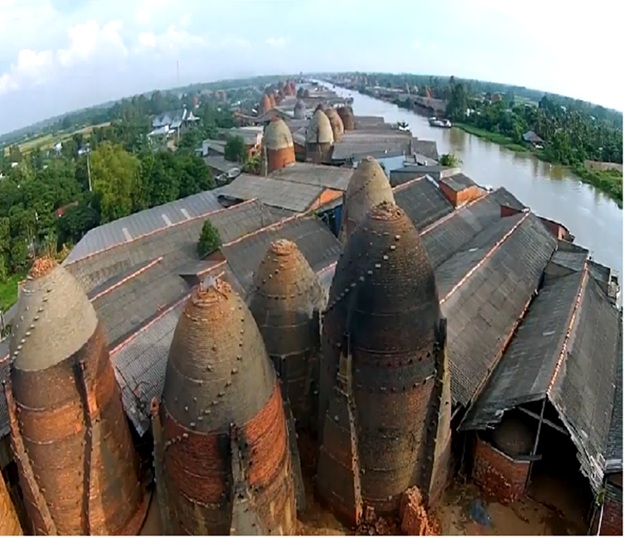

“Kingdom of Red Ceramic” on the northern bank of Co Chien River
For over one century, the local people in Vinh Long have known how to use the clay on the bank of the Co Chien River to make household ceramics, brick and tile in construction, yin and yang tiles – a kind of tile found in temples and pagodas. Around 1960, brick villages began to mechanize, producing with brick molding machine make hollow brick, solid brick and terra cotta tile. Until 1980, when a German company came to this region to produce pottery for export. Their staff who go to Binh Duong and Bien Hoa to learn how to make pottery.
Technically the same but in terms of products, Vinh Long red ceramic is a typical type that Eastern provinces cannot produce because of different materials. How generations creatively and molded into an excellent earth burning technique: brick kilns. Fuel fired from the typical product of the wet rice area: rice husk. The Vinh Long people have a typical delta culture. The typical color of Vinh Long pottery is the color of straw and clay rich in aluminum that is exploited locally. It is the only place in the Mekong Delta – and even in the entire Southeast Asia – that has clay containing aluminum sulfate, a substance producing the typical white stains that made products produced in Bavaria, Italy, Germany, France and Switzerland so popular
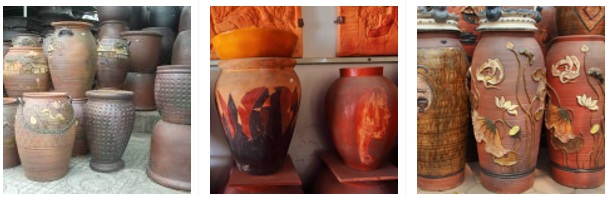 Some pictures illustrate Vinh Long red ceramics
In the 1980s, the villagers started making household such as vases, pots and jars, and artistic pottery ceramic: statues, flowerpots, other artworks such as terracotta (or red ceramic), an item highly appreciated in Australia, New Zealand, Great Britain and the US.
Along the 30 km of the Co Chien river basin, ceramic kilns that look like giant bowls down hide crowds of potters busy with their work.

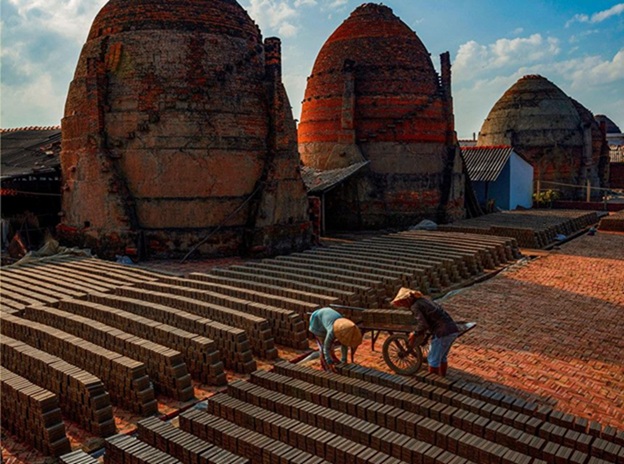
Worker outside kiln red ceramic
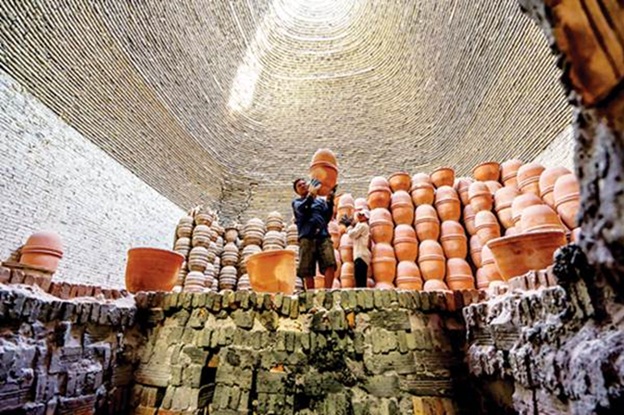 Worker intside kiln red ceramic
Difficulties in integrating the market economy
The Cuu Long (downstream of the Mekong River) Delta province has about 800 kilns of pottery producers, most located along Co Chien River in the border area Mang Thit – Long Ho districts of Vinh Long Town.
Pottery production in Vinh Long province has developed strongly in the years of 1997-2008. Many enterprises have invested to expand production, self-study to improve the process of making products. In 2007, According to Mr Huynh Huu Duc, deputy director of the provincial Department of Industry, said that most of the Vinh Long terracotta products are exported but only four to five producers have direct export contracts. Besides, most producers export their terracotta products via intermediaries, who take a significant cut of the profits
Rice husk prices have continuously increased year by year. In the favorable harvest season, rice husk is purchased for 600,000 VND / ton (about $26/ton) at the mill factory. When production is lower, rice husk is rare, the price is up to 1,000,000 VND / ton (~ $43/ton)
Today, manufacturers in Vinh Long no longer roast pottery with manual rice husk kilns as before. They baked pottery with gas ovens, dried electric ceramic products
In addition, transportation costs also increase, labor costs also increase, but the price of finished products does not increase because it increases, it will be difficult to compete.
According to the profession for nearly 30 years, Mr. Huynh Phuoc Tan – Owner of Tay Son brick production facility (Nhon Phu commune – Mang Thit district) – said:
“About 10 years ago, the clay source in Vinh Long has gradually depleted, I have to go to Hau Giang, Tra Vinh province to buy clay, but unavailable to buy.”
Vinh Long ceramic tile firing profession is also degenerating due to the trend of using new non-heated materials such as a mixture of cement fiberglass aggregate. However, in cases producers know how to exploit, the remaining kilns can be combined to develop tourism..
Please kindly Contact us for sourcing products: vietnam red ceramic or manufacturers or Inspection service in Vietnam
